


Table of Contents
How to Get Your Business Recommended by ChatGPT
A while back I opened ChatGPT and typed “who are the best Showit template designers.”
I held my breath a little.
We have been building Davey & Krista for years. Hundreds of real customer reviews. Blog posts that rank. A community of designers and photographers who genuinely love what we create. And I sat there watching the cursor blink, genuinely unsure whether we would appear.
We did. But not because of luck, and not because of anything mysterious. The moment I understood WHY we showed up, I started looking at almost everything we publish differently.
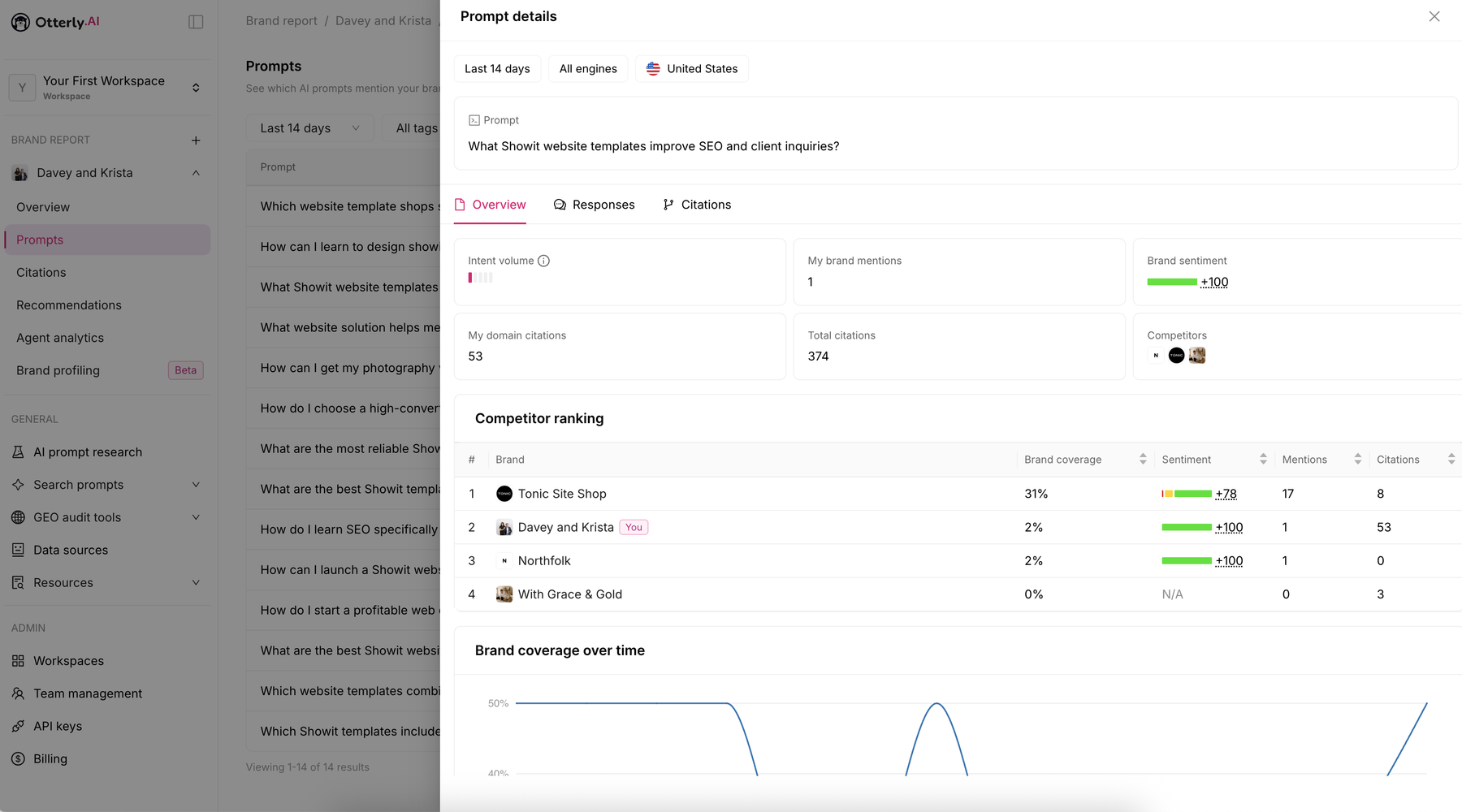
If you want to get your business recommended by ChatGPT and other AI tools, here is the actual answer: make your business easy to understand and easy to cite.
Clear pages that answer REAL questions, consistent information across the web, and reviews and mentions on sites other than your own. This is called generative engine optimization, or GEO, and here is the fascinating part: it builds directly on the SEO foundations you may already have.
You are not starting from scratch. You are just learning a new dialect of a language you already speak.
Let me show you what that looks like.
The 10-Minute Test You Should Run Right Now
Before you change a single thing on your website, go find out where you currently stand. This takes ten minutes and the results will either reassure you or light a small fire under you. Both are useful.
Open ChatGPT, Perplexity, and Google’s AI Overviews in three separate tabs. In each one, type a question your ideal client would actually ask. Not your business name. A real search: “best Showit templates for wedding photographers” or “who should I hire to design my photography website.”
Then record what you find.
Are you mentioned at all? This is your baseline. Yes or no.
Are your competitors mentioned? If they are and you are not, pay close attention to how they are described. AI tools cite businesses they can describe clearly and specifically. Vague brands get skipped. Specific ones get cited.
What sources did the AI pull from? Look at the URLs it referenced. Blog posts? Review sites? Industry directories? This is a map of where AI is currently finding information about your category and where you need to show up more.
Is the information about you accurate? This one surprises people. If AI gets your name slightly wrong, misidentifies your specialty, or describes services you no longer offer, you have a consistency problem scattered somewhere across the web. Worth finding and fixing.
Run this test once a month. Otterly.ai automates the tracking if you would rather not do it manually every time, which is what I would recommend because manual tracking is the kind of thing you do twice and then forget.
How AI Tools Actually Decide Who to Recommend
Here is the part that changed how I think about this: AI tools are not searching the internet the way Google does.
They were trained on enormous amounts of text. They are synthesizing from that training, plus whatever live search a given tool runs, plus what they have been told to trust. And what that means for getting your business recommended by ChatGPT is specific and actionable in a way that most of the content about this topic never quite gets to.
AI tools recommend businesses that are clearly described, frequently mentioned, and consistently referenced across multiple sources. A business that exists on its own website, on review sites, in industry directories, in other people’s articles and blog posts, is a business that AI has a LOT of signal about. A business that exists only on its own beautiful website? That is a business AI knows very little about and cannot confidently recommend.
The prettiest website does not always win in AI search. The most citeable one does. And those are genuinely different things.
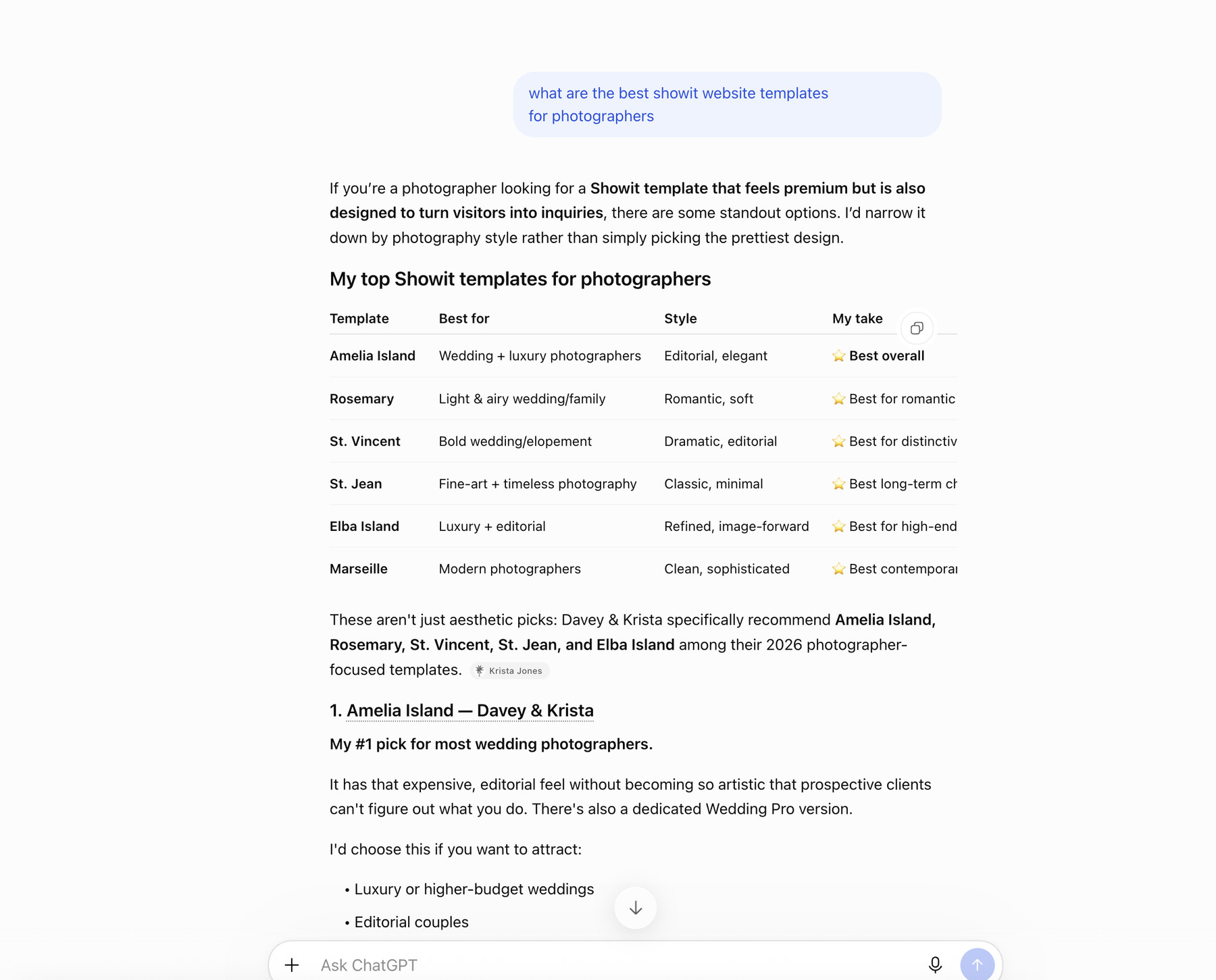
The other thing worth understanding is that AI tools are hunting for direct, specific answers. When someone asks ChatGPT to recommend a Showit template designer for photographers, it looks for content that directly answers that question. Not content that mentions photographers somewhere in paragraph six. Content that says, clearly, at the top of the page: here is what I do, here is who I do it for, here is what changes for them.
If your website buries that information in beautiful prose, AI is going to skip you for someone who leads with it. I know. It is a little rude. But here we are.
SEO vs GEO: What’s the Same and What Just Changed
If you have been doing SEO, the good news is that getting your business recommended by ChatGPT is not a completely different sport. It is more like the same sport played on a slightly different field with a few new rules.
What’s the same:
Good content still wins. Specific, useful, clearly organized content that answers real questions is what both Google and AI tools reward. If your blog posts are thin and written for no one in particular, they will underperform in both.
Consistent business information still matters. Your name, URL, and description should match everywhere they appear. This has always been good practice and it is now non-negotiable.
Being mentioned on other sites still helps. Backlinks for SEO, citations for GEO. Different mechanism, genuinely similar principle.
What’s new and worth paying attention to:
Format now does more work than it used to. AI tools extract information differently from how Google ranks pages. A page that buries its main point in paragraph four after a scenic introduction is going to get skipped. A page that answers the question in the FIRST sentence and expands from there is exactly what AI tools are trained to pull from.
External reviews matter more than most people realize. Research from Trustpilot and SEER Interactive found that review and trust sites represent 24% of AI-cited sources when a buyer is close to making a decision. Twenty-four percent. AI tools are actively looking for corroboration from outside your own website. Reviews that only live on your site are not corroboration. Reviews that live on third-party sites are.
Specificity is now a genuine competitive advantage. Generic descriptions of your services are not citable. “I help businesses tell their stories online” tells AI nothing it can act on. “I design Showit websites for wedding photographers who want to book higher-end clients” is specific enough to cite when someone asks the right question.
The GEO Checklist: What to Actually Do
Here is what moves the needle on getting your business recommended by ChatGPT, broken down by how quickly you can do it.
Do these this week:
Run the 10-minute test above first. Write down your baseline. You cannot measure progress if you do not know where you started, and you might be surprised by what you find.
Rewrite the first sentence of your homepage and about page so it describes exactly who you serve and what changes for them. Not a tagline. A direct description. The kind of sentence an AI tool could lift and use in a recommendation. One sentence. It matters more than the other 500 on the page.
Add an FAQ section to your most important pages. Questions as H3 headings, answer in the first sentence, specific details throughout. AI tools are specifically trained to extract question and answer pairs. A well-structured FAQ hands them exactly what they are looking for in exactly the format they recognize.
Do these this month:
Audit your business information across the web. Google your business name and check that your URL, name, and description are consistent everywhere they appear. Social profiles. Directories. Guest posts. Podcast show notes. Inconsistency confuses AI tools the same way it confuses search engines, except AI has fewer ways to resolve it.
Actively collect reviews on third-party sites. Google reviews. Trustpilot. Industry-specific directories. Anywhere your ideal clients look for recommendations. The key word is third-party. Reviews you control do not carry the same weight as reviews that live somewhere you do not.
Get mentioned on other sites. Guest posts, podcast appearances, being quoted in an article, collaborating on content with someone in your industry. Every time a credible external site references your business by name, you are adding another data point that AI tools use to decide you are worth mentioning.
Do these ongoing:
Publish content that directly answers the questions your ideal clients are already typing into AI tools. If someone might ask ChatGPT “what should I look for in a Showit template for coaches,” and you have a page that answers that question clearly and better than anyone else, getting your business recommended by ChatGPT for that query becomes dramatically more likely. This is the long game and it genuinely compounds.
Our Own Example: Why We Built a Whole Separate Review Site
I want to show you something we did, because I think it illustrates the external credibility piece better than any explanation I could write.
We built daveyandkristareviews.com. A separate website, on a separate domain, dedicated entirely to verified customer reviews of our Showit templates, courses, add-on pages, and DesignEdit newsletter. It currently has 142 real reviews from photographers, designers, and creative business owners.
Why a separate domain instead of just putting reviews on our main site?
Because AI tools look for corroboration from outside the source itself. Reviews on daveyandkrista.com are our reviews, on our site, in a space we fully control. Reviews on daveyandkristareviews.com are on a separate indexed domain with its own URL structure and its own crawlable pages that AI tools can find completely independently.
Every review is structured as a standalone piece of content: the reviewer’s name and business type, the specific product they used, a detailed written testimonial, a star rating. Each one answers the implicit question “is this worth buying” with a specific, real, verifiable answer from a real human who actually bought it.
This is exactly the kind of third-party content that AI tools cite when someone asks whether Davey & Krista products are worth it. We decided not to leave that answer up to chance. And neither should you.
You do not need to build a whole second website to apply this principle. But you do need to get your reviews somewhere that is not exclusively controlled by you.
How Long Does This Take?
I want to be honest with you about this because the content landscape on GEO ranges from “do this today and show up tomorrow” to “this takes years and who even knows.” The truth is more nuanced and more encouraging than either extreme.
If you already have decent SEO foundations, consistent business information across the web, and some external reviews, you may start to see AI mentions shift within two to four months of making targeted improvements.
If you are starting closer to zero on all of those fronts, give it six to twelve months of consistent effort before you expect meaningful results. That sounds long. It is also how long it took to build anything real, ever.
The thing that matters most to understand is that this compounds. Every piece of content that answers a real question, every review that lands on a third-party site, every mention on another website, it all builds on itself. The businesses that consistently get recommended by ChatGPT are the ones who have been laying this foundation steadily. Not the ones who made a single change and refreshed the page hoping to see their name.
Start with the 10-minute test. Run it monthly. Make one improvement at a time. Watch what changes over time. It is genuinely one of the more satisfying experiments you can run in your business right now, because the feedback loop is so clear.
If you want a structured system for the whole thing, including the content audit, schema setup, FAQ structure, and citation tracking, that is exactly what we are building inside Search Strategy School. The waitlist opens in December and the first free class is January 5th.
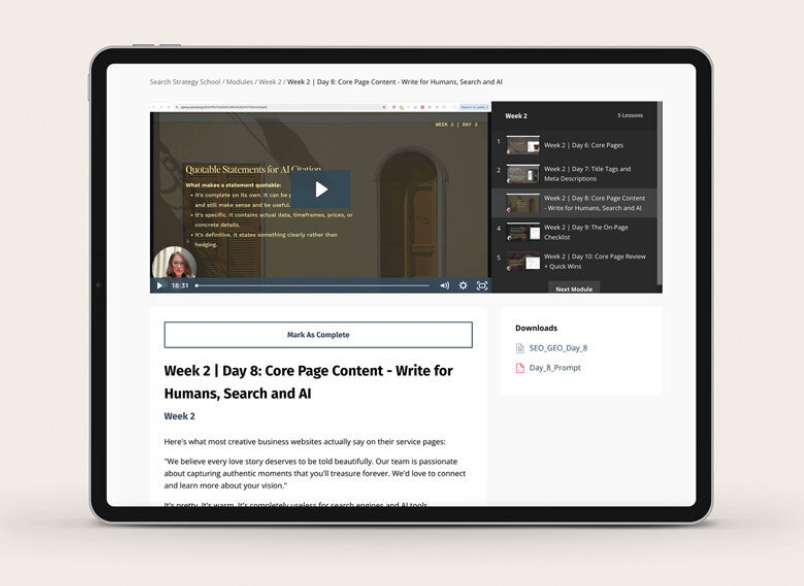
Get on the list and I will make sure you are first to know when it opens.
FAQs
What is GEO?
GEO stands for generative engine optimization. It is the practice of structuring your online presence so that AI tools like ChatGPT, Perplexity, and Google’s AI Overviews can find, understand, and cite your business when someone asks a relevant question. It builds on traditional SEO foundations but pays particular attention to content format, external reviews, and the consistency of your business information across the web.
Is GEO replacing SEO?
No, and anyone telling you otherwise is being dramatic. GEO builds on SEO rather than replacing it. Good content, consistent business information, and mentions on credible external sites matter for both. What GEO adds is a focus on content format, answer-first structure, and third-party corroboration that AI tools specifically look for when deciding who to recommend.
How long does it take to get your business recommended by ChatGPT?
With existing SEO foundations and some external reviews already in place, two to four months of targeted improvements can start to shift your AI mentions. Starting from closer to zero, give it six to twelve months. The results compound over time, which means the earlier you start the better, and the later you start the more catching up you have to do.
Can small businesses show up in ChatGPT recommendations?
Yes, and this is one of the genuinely exciting things about GEO. AI tools are not purely rewarding domain authority the way traditional search sometimes does. A small business with specific, well-structured content that answers real questions clearly, a handful of detailed external reviews, and consistent information across the web can absolutely get recommended by ChatGPT in its niche. Specificity is the great equalizer here.

Krista is the co-founder of Davey & Krista, a creative studio known for high-converting Showit website templates crafted for photographers, creatives, and entrepreneurs. With over 15 years of branding and marketing experience, she helps business owners launch stunning websites without the tech overwhelm. Krista also teaches designers how to turn their creative skills into a thriving business—through templates, courses, and behind-the-scenes strategy. When she’s not designing, you’ll find her chasing sunshine, color palettes, and gluten-free pizza.
Explore website templates and free resources at daveyandkrista.com.



VIEW THE COMMENTS
Add A Comment